
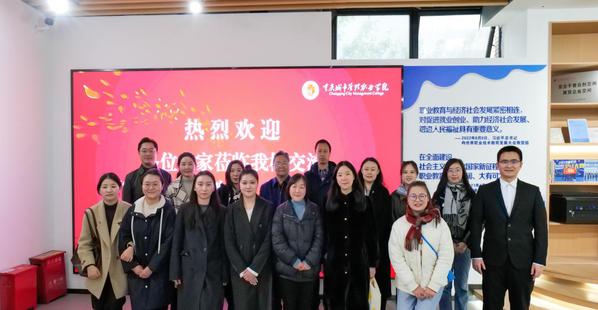
On the morning of December 5, Professor Lei Yong, Secretary-General of the Chongqing International Chinese Education Alliance, led a delegation of more than 20 experts participating in the “Chinese + Vocational Skills Education” thematic seminar organized by the Sichuan-Chongqing Regional Mechanism for International Chinese Education Cooperation to visit our university for research and exchange activities on “Chinese + Vocational Education.” The participants included heads of international cooperation and exchange departments from universities in Sichuan and Chongqing, as well as experts in international Chinese language education.
At 9:00 a.m., accompanied by the project leader from School of Business and staff from the International Cooperation and Exchange Center, the experts visited four training facilities: the SF Express Station at the School of Business, the Smart Logistics Student Competition Preparation Base, the Smart Logistics Full-Process Training Base, and the Modern Logistics Training Center. During the tour, instructors and student volunteers at each station provided detailed explanations regarding the facility’s development, practical training, skills competitions, industry-academia collaboration, and international talent development. The experts exchanged views and spoke highly of our school’s innovative approaches in the field of “Chinese Language + Smart Logistics,” particularly regarding the deep integration of industry and education, the creation of realistic training scenarios, and the practical focus of talent development.
Following the tour, both parties held a discussion in the conference room of the Logistics Training Center. Sun Yuzhong, Director of the International Cooperation and Exchange Center, and faculty members from the Modern Logistics Management program participated in the exchange. Attendees engaged in in-depth discussions on topics including innovation in the “Chinese Language + Vocational Skills” educational model, curriculum resource development, the development of a dual-qualified faculty, and international collaboration between the university and industry.
Experts agree that integrating Chinese language education into the entire process of logistics vocational training is an effective approach to cultivating high-quality, internationally-oriented technical professionals who are proficient in Chinese, skilled in logistics, and well-versed in Chinese culture. Educational institutions in Sichuan and Chongqing should further strengthen collaboration, share resources, and jointly build the “Chinese + Logistics Vocational Education” brand to support the “Belt and Road” Initiative and the high-quality development of the regional economy.
In his concluding remarks, Lei Yong fully affirmed the school’s proactive exploration and solid achievements in integrating “Chinese language + logistics vocational education” into its educational approach. He noted that this research exchange visit served not only as a vivid example of on-site teaching but also as a significant practical step toward the coordinated development of vocational education in Sichuan and Chongqing and their joint contribution to national strategic objectives. He hoped to use this event as an opportunity to further promote interaction and cooperation among institutions in the field of international talent development, and to jointly enhance the internationalization and influence of vocational education in the Sichuan-Chongqing region.